She makes her


╰┈➤ You can visit her website at https://www.marylawlor.net/.
Connect with her on social media at:
╰┈➤ Facebook: https://www.facebook.com/mary.lawlor.186/

Thank you so much for this interview, Mary. How did your family feel about having you write a book that might include them?
My parents were both gone by the time I wrote Fighter Pilot’s Daughter, and one of my older sisters had passed away. I was worried about how my other two sisters and the larger, extended family would feel about my describing intimate dynamics in the book, like my parents’ fighting or my father’s alcoholism. But my sisters and I talked about these things, and they were supportive. Before publication, I sent them both the finished manuscript — not promising to make changes but to hear their feedback and be influenced or not by it. I know one of them has read the entire book, and she was very moved. Her response has meant the world to me.
What was it like living in military quarters and never having a ‘real’ home that stayed in the same place? Do you feel it shaped who you are today?
In some ways, it wasn’t so much of an issue, since from the time we were very young, my sisters and I were moving every two years or so. It was all we knew and all we expected. The other kids on the Army posts where we were stationed had the same experience.
But a couple of things complicated that normality. Whenever they could, my parents enrolled us in Catholic schools, off post, and we would find ourselves surrounded by kids who had known each other since kindergarten. Generally, they looked at us like we were irrelevant — at least at the beginning. Eventually we’d make friends and be invited to their homes, where we’d see the continuity and stability of their lives, in contrast to our own.
And there were the visits to see our New Jersey cousins, who lived in a lovely house in a country town where they’d been all their lives. They’d gone to the same school, had the same friends, and so forth. It was an ideal domestic scene, and I loved being there. I was envious of their world but couldn’t imagine it for myself. It was too far out of reach.
When we were young, the moves were exciting. My parents would talk about the places we were going — California! Germany! — and my sisters and I would start imaging what they would be like. We’d read about and picture ourselves in the new situation. As we got older and had close friends and boyfriends, the moves were more difficult. It was sad and painful to have to leave, and we wished very much we could stay in the same place. Then, again, the new place would be exciting and different. We’d make new friends, and the cycle would continue like that.
Moving so much and not having a home has shaped me a great deal. After leaving my parents for college, I kept moving and am still am not quite rooted, although I’m married and have a nice house in Easton, Pennsylvania. But every three months my husband and I shift off to Spain, where we have a cabin in the mountains of Andalucía. I love being in Spain and would move here if I could. We have friends and more of a history here than we do in Easton. We don’t, however, have residency in Spain, so after three months, we come back to Easton. The year is divided up like this, and it feels perfectly familiar to me.

In one of your interviews you said, “Memories of my girlhood and forgotten fears of nuclear apocalypse were running through my brain day and night.” I can’t imagine the fear. Can you elaborate on this and tell us how you coped?
Living on military posts, I think we had more of a sense of the potential for nuclear war than other children in America. Because our fathers’ jobs were to get the defense apparatus ready for that eventuality, we were made constantly aware of it. Civil-defense shelters were everywhere, and we practiced the “Duck and Cover” moves at school, huddling under our desks and hoping that would do the trick! On the posts in Heidelberg and Stuttgart, Germany, there was a lot of talk about the Fulda Gap, a point on the border between West and East Germany where it was predicted the Soviet army would flood through to do battle with the Germans and the rest of Europe. These images and warnings kept the possibility of nuclear apocalypse in our minds almost all the time.
Apart from that, our parents were practicing Catholics, and the story of St. John’s Apocalypse often came up in the post chaplain’s sermons. Apocalypse offered a ready analogue to the talk of nuclear annihilation, and the chaplain would build on it, trying to imbue in us a sense of how close the end of world might be. The terrifying judgement of the living and the dead and the assignment of eternal damnation or happiness was always upon us.
These twin discourses of apocalypse were in the air, in our dreams and produced what I’d call a habit of fear, a trained response to seeing whatever troubling situation emerges as a sign of the end of days. Or the end of something. Like now, so many people my age are seeing the current political situation in the US as signs of the end of democracy and, perhaps, of America. But on a more personal level, the habit of fear has stayed with me and been a real handicap to my self-development and to my ability to genuinely live with confidence. Fortunately, it’s an obvious enough problem that I’ve known about it for a long time and have spent a lot of time (and money!) trying to come to terms with and manage it in therapeutical contexts.
Can you tell us the name of some of the places you have traveled to when your father was an aviator and which were your favorite?
We lived in Camp Lejeune, North Carolina, infamous as a cancer hot-spot for people who lived there in the 50s. Then there was Fort Rucker, in Dothan Alabama, where my father taught pilots how to fly helicopters and I got to ride in a Bell helicopter once — like being up in the air inside a giant eyeball. We rented a farm way out in the country and had a horse, cows, chickens, guinea hens to look after. That was hugely fun, although rural Alabama was a very unfamiliar place and the people there weren’t easy for us — especially for my mother — to understand. I go into Franny’s way of responding to southern culture in the book, but suffice it to say here that she was quite unhappy. Later we moved to Fort Benning in Columbus, Georgia, where we lived off post in a swampy development called Forestdale. There was a creek behind the house, but you had to watch out for water moccasins. I started my writing career there with a little newspaper a friend and I created, The Forestdale Gazette, in which we reported news of the neighborhood, using carbon paper for copies.
Later we moved to Fort Ord, in Monterey, California. This was really my favorite and my sisters’ too. We lived on post, but our parents enrolled us in the beautiful Carmel Mission School in Carmel, situated in an old monastery and arranged like a cloister walk around a gorgeous garden. We made friends there and loved the school, although some of the nuns were stricter than others. We stayed at Fort Ord long enough for my older sisters and me to start high school in Monterey. Then my father had orders to go to Stuttgart, so we had to say goodbye to people who had become important to us.
We crossed the Atlantic on the SS United States, an adventure in itself, which I also recount in the book. Germany opened up a whole new world. The enormous differences of language, styles of dress and manners, of what kids were allowed to do that they weren’t in the US and vice-versa, not to speak of the economic differences between them and us in those days — all these surprises were overwhelming. But it was fascinating. I scrambled to learn the German language and understand the few German friends I made. For the first couple of years we were in Stuttgart, a beautiful industrial city, and then we moved to Heidelberg, a handsome and historic university town. In both places we lived in the very closed environment of the post and didn’t get to know German people or their language or society very well. Among the military kids, my sisters and I came of age and got a taste of American teenage life that we’d never had in the States — drinking parties in the local Gasthauses that had no drinking age, and moonlit adventures in old Nazi sites. It was a strange and exotic experience which made me into a very different person than I’d been before.

Having lived through the Cold War, you know the fear of Russians invading or setting off a nuclear weapon was very real. Can you help us feel what that was like?
We were shown films in school with images of an enormous blast, followed by empty streets with trash blowing in the nuclear wind. The announcer would insist again and again that if we heard the atomic warning siren, we were to “duck and cover,” wherever we were. And we were told there might be no warning, that a blast as bright as the sun would suddenly happen, anywhere, anytime. Duck and cover movies warnings were played in schools and in the base movie theaters. Readiness warnings were issued at sports events and even in church. Repeatedly, we were told to be always alert for the warnings or the sun-bright blast itself. The message was meant to live in our psyches and be part of our thinking, our identity. We were people under threat. Nuclear holocaust was in my dreams and fueled a steady sense of fear and trepidation. From one moment to the next, you had to be ready for the world to fall apart under your feet. It was a tremendously unsettling discourse and kept all of us, I think, on edge and fearful.
I see this now in hindsight as a terrible experience for a child. Whatever the actual threat level at any given moment, ducking and covering probably wouldn’t have helped much. It only left us with a habit of fear. It probably made some of us more philosophical or religiously-minded than we might otherwise have been, given the end-of-the-world scenario we lived with all the time; but I think the more general effect was a fear, bordering on neurosis, of what could happen from one moment to the next. No wonder the late counter-culture that followed saw such an explosion of liberation and care-lessness, to counteract the intense, imposed caution of our childhood years.
In an earlier interview, you said you just wanted your mother and father to be remembered. Can you tell us what you would like people to know about them?
I think Jack and Franny were in some ways typical of their generation. Born in the 20s, they lived through the depression and came of age in the second World War. They weren’t subtle but saw things in black and white terms; and were very clear with their comments about everything from politics to homemaking. In many ways, I think they thought of themselves as opposite to the communists who they considered the enemy: communists were subtle, cagey, didn’t put their cards on the table. You couldn’t trust people like that, since what you saw wasn’t necessarily what you got.
Jack and Franny were both larger than life for me, but others outside the family responded to them as if they too saw them as striking characters. They were outspoken and definitive in their opinions. They were both loud and ready for an argument. I never heard them identify themselves as such, but they were politically independent and would size up the candidates carefully, then decide which was the better man (it was always, of course, a man). And once decided, that was it. There was little room for dialogic discussion of things, much less changing their minds.
As parents, they could be very difficult. They were strict, demanding, and kept a close eye on my sisters and I. They weren’t alone: child-rearing was like that in those days. Kids got spanked, and nobody thought it was wrong. My parents set the rules and the tone for our household, and we followed. There was no consulting us as to what we thought or hoped for or worried about.
But they were affectionate, and we knew they loved us. They hugged us a lot and always made a big deal of our birthdays. Christmas was a huge celebration with lots of good presents. And Jack and Franny were fun. Our moves across the country were always treated like adventures. The hotels, the pancake breakfasts at roadside restaurants, the sites along the routes of America — Carlsbad Caverns, Route 66, the Rocky Mountains — were part of a great expedition we were making. They inspired us with their excitement.
At a certain level, I suppose it’s simple vanity: I want them to be remembered because they meant so much to me. But they both contributed something to the world they came of age in, and they were characters of that time. I think that’s worth remembering.

What would you like future readers of your book to know?
I’d like future readers to know what life was like in the middle-to-late years of the twentieth century, particularly for the children of military families, a generally little understood component of American society. The focus of attention to US forces fighting overseas and preparing for war at home is usually on the service members themselves — all their adventures and sacrifices. I’d like readers to know more about the people who came along with them, followed in their wake — the spouses and children of the warriors. They may well not share the warrior’s priorities or even their ideology, but the children in particular are called on to be part of the picture anyway, like camp followers of all ages everywhere. I’d like people to know more about what life was like for us in our time, but I also hope readers will see how military children still experience the difficulties of moving all the time and the instability of life in warrior society. It’s an age-old portrait and one that’s little understood.


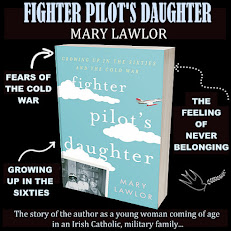
Fighter Pilot’s Daughter: Growing Up in the Sixties and the Cold War tells the story of Mary Lawlor’s dramatic, roving life as a warrior’s child. A family biography and a young woman’s vision of the Cold War, Fighter Pilot’s Daughter narrates the more than many transfers the family made from Miami to California to Germany as the Cold War demanded. Each chapter describes the workings of this traveling household in a different place and time. The book’s climax takes us to Paris in May ’68, where Mary—until recently a dutiful military daughter—has joined the legendary student demonstrations against among other things, the Vietnam War. Meanwhile her father is flying missions out of Saigon for that very same war. Though they are on opposite sides of the political divide, a surprising reconciliation comes years later.
⤷Read sample here.
⤷Fighter Pilot’s Daughter is available at Amazon.
╰┈➤Book Details
Genre: Memoir
Sub-genre: Women in History / Military Leaders Biography
Language:English
Pages: 323
Paperback ISBN: 978-1442222007
Kindle ISBN: 978-1442222014
Publisher: Rowman and Littlefield
Format: Hardcover, Paperback, Kindle, Audiobook
╰┈➤Here’s What Readers Have To Say!
“Mary Lawlor’s memoir, Fighter Pilot’s Daughter: Growing Up in the Sixties and the Cold War, is terrifically written. The experience of living in a military family is beautifully brought to life. This memoir shows the pressures on families in the sixties, the fears of the Cold War, and also the love that families had that helped them get through those times, with many ups and downs. It’s a story that all of us who are old enough can relate to, whether we were involved or not. The book is so well written. Mary Lawlor shares a story that needs to be written, and she tells it very well.” ―The Jordan Rich Show
“Mary Lawlor, in her brilliantly realized memoir, articulates what accountants would call a soft cost, the cost that dependents of career military personnel pay, which is the feeling of never belonging to the specific piece of real estate called home. . . . [T]he real story is Lawlor and her father, who is ensconced despite their ongoing conflict in Lawlor’s pantheon of Catholic saints and Irish presidents, a perfect metaphor for coming of age at a time when rebelling was all about rebelling against the paternalistic society of Cold War America.” ―Stars and Stripes


╰┈➤ You can visit her website at https://www.marylawlor.net/.
Connect with her on social media at:
╰┈➤ Facebook: https://www.facebook.com/mary.lawlor.186/

What inspired you to write your memoir?
When I started writing Fighter Pilot’s Daughter, Mad Men was still airing, and the Cold War was its entire cultural nest. And President Barack Obama had just signed the New START Treaty with President Dmitry Medvedev of Russia. Like START I, signed by the first President Bush and Mikhail Gorbachev, START II limited the number of nuclear warheads and missiles in both the US and Russia. It was an effort to bring about a real end to the Cold War and the threat of nuclear war we’d been living with since the 1950s (and still are). Memories of my girlhood and forgotten fears of nuclear apocalypse were running through my brain day and night.
Back in those days, the fears were abstract as well as tangible. I grew up in a military family. My father was an aviator. Every two years, in response to demands from the Defense Department, we packed up all our cups, plates, sweaters, books, and everything else. The movers would come and take everything away, and off we’d go, by car, plane, or ship to the next posting — Florida, Alabama, North Carolina, California, Germany. By the time I was ready for college, we’d lived in I don’t know how many places and I’d been to 14 schools.
Outside our household, the Cold War climate kept fear hovering in the air all the time. Especially in Germany, we were constantly afraid the Russians would invade or set off a nuclear weapon. The earth would become a nightmare of emptiness, loneliness, hunger. Competition for survival would be vicious.
Through the years of college, graduate school and my work as a professor of literature, echoes of that upbringing moved to the background but kept driving things in the foreground. I moved a lot. I had difficult relationships with friends and boyfriends. Looking at Mad Men and seeing Obama sign that treaty, I saw more clearly how the fears and all the moves of my youth were part of that larger Cold War narrative. I revisited the photo albums my mother made and studied my father’s military record. A narrative of my own started taking shape in my head. I scratched out a draft, then another and another. Writing Fighter Pilot’s Daughter helped sort out and make sense of the complicated past, not just of my own life but the bigger picture of those fractious and difficult years in the life of the nation.
What message do you hope to convey to readers with your book?
I want readers of Fighter Pilot’s Daughter to come away with a deeper understanding of what military kids and spouses experience. I hope the book will show people how complicated it is for these dependents (a fraught word, but it’s the term used in military circles) of service people to maintain healthy and happy family lives when they have to move all the time and when they spend long months separated from the father or mother who’s deployed to war.
The book is also about our patriotic culture, our many wars, and the perhaps inevitable reactions of young Americans to a national identity based on that sort of power projection. I’m thrilled when readers write to say the book has helped them remember and think about events of the time and see how much they’ve shaped history since.
I also have to admit that I’d like my mother and father to be remembered! They were complicated, fascinating, larger than life people. I suppose a lot of people can say that about their parents, but mine were hugely so for me. There are far more stories about them than I was able to recount in Fighter Pilot’s Daughter; but it makes me happy to hear from readers that they feel they know Jack and Frannie; and that they have an idea of what my early life was like. It makes me feel somewhat less of a stranger everywhere I go.
What was your childhood like?
I’ve said a lot about this already, but I’ll add here that there was a lot of tension in our house because of all the moving. Mostly we lived in military quarters and never had our own home. And my father was away from home a lot of the time — on a ship off the coast of Guatemala waiting an invasion to begin, or in northern Turkey investigating a fly-over of the Soviet border, or somewhere close to the border with East Germany, keeping tuned to news from the Fulda Gap. In these and other situations too frightening for my sisters and I to know about, he kept us in suspense from far away. We were happy when he came home, but without meaning to, he frightened us. He’d walk through the door, his head nearly touching the ceiling, his blue eyes lit with a long-distance gaze. It was like he hadn’t really landed. He had gifts. He told stories. But he wasn’t really home yet, and we weren’t sure who he was.
Throughout your childhood, and besides your parents, did you have people in your life that stood out and made a difference?
My Aunt Sandy and Uncle Philip Walsh and their children, my cousins, who lived in New Jersey were always a model for me of the kind of stability I always dreamed of. They lived in the same town and the same house until they were all grown up. They had their complications too, and not everything went perfectly smoothly as my cousins grew up. But they were energetic, imaginative people — and there were a lot of them. Their stability and intelligence meant a lot to me.
If you were to trade places with your father, how would you change his perspective on life? Do you see anything you would have liked to change about him?
My dad was a decorated war hero. My mother, my sisters and I lived in the glow and the shadow of his dangerous, turbulent life. Through all our many moves — I went to 14 schools before I turned seventeen — I remained a good Catholic, a good patriot, and a good student. But when I came of age in the late sixties, I turned away from much of what I’d been taught. Suddenly, the way of life I’d absorbed at Catholic schools and from uncounted patriotic sermons appeared distant and wrong. And all that my father had done in the Korean War and was still doing in Vietnam appeared in a different, darker light.
The confrontations between my father and me as a result of my involvement in the Paris demonstrations shattered my ties to the family and marked my psyche in ways I’ve tried for years to understand better. I was deeply conflicted about my parents at the time, especially about my dad. And I didn’t know how I felt or should feel about myself as the daughter of the man who flew the bombing and strafing missions he did. I wrote the book both to produce a fuller and more nuanced picture of those difficult times and to find a way beyond my own anger at parents I also loved, respected, and missed. Writing Fighter Pilot’s Daughter helped me understand their choices much better than I had in the past.
Will there be a second memoir?
That’s an interesting question. I think about it from time to time, and one of these days I might actually sit down and do it. My husband and I live in Spain half the year and went through a lot buying the property we own there and building our little house. There are zillions of stories to tell about those years. It would be interesting to pick up the narrative from Fighter Pilot’s Daughter and try to connect the different but related experiences. And, of course, the times we’re living through right now bring the Cold War back into view, and I’d really like to roll up my sleeves and write that story too.
Please share what’s next for you?
I’ve just finished a historical novel called The Translators, based on the lives of two medieval priests who traveled from England and Croatia, respectively, to northern Spain in the 1140s. They met and became intimate friends, learned Arabic and translated works in the libraries that once belonged to the emirs of al-Andalus (what the southern part of the Iberian Peninsula was called when it was Arab and Muslim). I’ve fictionalized much of the priests’ lives for the novel but relied on extensive research on the history of the time. A lot of the tension in the story arises from the Church’s attitude toward the books the priests translate for Christians to read. The climax involves the English priest’s sister, who escapes the chaos of home to meet her brother in France, where she helps him and his friend overcome their personal tensions and, indirectly, resolves their struggles with the Church.


Fighter Pilot’s Daughter: Growing Up in the Sixties and the Cold War tells the story of Mary Lawlor’s dramatic, roving life as a warrior’s child. A family biography and a young woman’s vision of the Cold War, Fighter Pilot’s Daughter narrates the more than many transfers the family made from Miami to California to Germany as the Cold War demanded. Each chapter describes the workings of this traveling household in a different place and time. The book’s climax takes us to Paris in May ’68, where Mary—until recently a dutiful military daughter—has joined the legendary student demonstrations against among other things, the Vietnam War. Meanwhile her father is flying missions out of Saigon for that very same war. Though they are on opposite sides of the political divide, a surprising reconciliation comes years later.
⤷Read sample here.
⤷Fighter Pilot’s Daughter is available at Amazon.
*****
╰┈➤Book Details
*****
╰┈➤Here’s What Readers Have To Say!