Showing posts with label First Chapter Reveal. Show all posts

Tuesday, May 26, 2026

First Chapter Reveal: A Change in Plans by Mike Martin #mystery

9:00 PM 0 Comments


RCMP officer Winston Windflower’s rare afternoon off gets interrupted when a hit and run turns into murder and he must pull together a team of Mounties from Newfoundland to resolve the crime. Following the money and fentanyl— and bodies—Windflower and his team join forces with police officers in southern Ontario to take down an international drug-smuggling ring.

Windflower must face personal doubts and fears when fellow Mountie Fil Romano is kidnapped. While the higher-ups at HQ make plans to give safe passage to the drug lords in return for Romano’s life, Windflower worries Romano will get caught in the crossfire. Windflower again looks to his friends and allies for help in the difficult hours and days ahead. 

╰┈➤Book Details

  • Genre: Mystery
  • Sub-genre: TBA
  • Language: English
  • Pages: 278
  • Paperback ISBN: TBA

A Change in Plans is available at Amazon.

╰┈➤Here’s What Readers Have To Say!

“When a Mountie is kidnapped, it further complicates matters. As the tension keeps increasing, the action reaches a fever pitch. This author knows how to keep the plot moving swiftly to keep readers hooked. You will enjoy spending time with Windflower, a hero who’s clever, brave, and endlessly resourceful.” – Steven Finkelstein
Readers cannot help but enjoy this series. Even though there are some nail biting, adrenaline pumping things going on, it is balanced out by the personal parts of the story. Yes, Windflower could be chasing down a killer or a drug dealer, but he is always grounded with his wife and two daughters, his friends and his community. I personally enjoy when he does his smudging and reconnects with his deceased Auntie and Uncle and gives back to the earth.” – Cozy Mystery Book Reviews

╰┈➤Read if you love…

🕵️‍♂️ Mystery 

😵̷̊̊̊̊̊ International Drug-Smuggling Ring

🥷🏻Kidnapping 

☠ Dead Bodies

💂🏻‍♂️Canadian Mounties to the Rescue

🎉Edge of Your Seat Excitement


First Chapter:

Summer was nearing its end in the small town of Grand Bank on the eastern shore of Canada. Winston Windflower, husband, father and RCMP officer, was enjoying some quiet time while his wife, Sheila Hillier, and their two girls, Amelia Louise and Stella, were in St. John’s for their annual back-to-school shopping spree. He was alone except for his four-legged friends. Lady, an eight-year-old collie, was still frisky and ready to go for a walk as always. Molly, the cat, was ageless and just about lifeless as she sat in her bed waiting for the next treat to fall in front of her.

It was a fine, sunny day as Windflower looked out of their home onto the Atlantic Ocean. Because it was so nice, he had taken the afternoon off for picking berries. The summer had been unusually hot and sticky, and that meant the berries were out a little earlier than usual. His fervent hope was that his special picking spot had not been disturbed by early pickers trampling down bushes and limiting the harvest.

If things went well, he could pick a gallon of berries in a couple of hours, and if he was super lucky, Sheila would make something fabulous with the blueberries when she got back. Maybe a pie or even one of her blueberry specialties. Windflower salivated when he imagined all of that deliciousness. He grabbed a couple of Tupperware containers and a bottle of water and then headed for his favourite spot.

There was a congregation of berry pickers at the closest picking location, just past the clinic. Bent over, they paid him little attention. He didn’t mind being ignored. The area was too busy and crowded for him. He took the trail down by the brook and then up the hill to the lookout. He paused for a moment to take in the majestic view of Grand Bank. Windflower glanced over the brook to the town and the wharf, all the way to the craggy outcrop that the locals called the Cape. Then he continued on up over the hill and towards the other side.

He veered off the path about halfway down and was very pleased to find his desired location calm and untouched. He said a silent prayer of thanks to Creator and began his task. Some people would have thought of this as work, but Windflower found berry picking both meditative and spiritual. It reconnected him to the land and made him think of his early days growing up on the reserve in Pink Lake, Alberta. His Cree family would all go berry picking for the day, bringing a lunch and a kettle to make tea.

He soon had one container filled and was working on the second when his pocket buzzed. He checked the number on his phone. It was Corporal Samira Gupta, his right-hand assistant, calling from the bigger community of Marystown. He had made arrangements with his boss, Superintendent Ron Quigley, that he would take the job as acting inspector for the region as long as he could stay in Grand Bank and have an assistant in Marystown. Gupta filled her role perfectly.

“What’s up, Corporal?” asked Windflower.

“Sorry to bother you,” said Gupta. “Betsy said you were off. But I thought you should know. We had a hit and run in Marystown. Over near Walmart. A woman in her forties is in hospital. Sergeant Tizzard is on the scene.” Eddie Tizzard was one of Windflower’s long-time friends and co-workers. They’d been working together for the last 10 years in one way or another.

“That’s a dangerous area,” said Windflower. “How is the woman?”

“She was unconscious when they brought her to the hospital in Burin,” said Gupta. “But no other information so far.”

“And the driver?”

“We’re working on it. Tizzard has a team doing interviews from the scene.”

“It’s busy around there. Somebody would have seen something.”

“That was our thinking, too,” Gupta agreed. “If we don’t get anything back soon from the canvass, we’ll do a media hit.”

“Perfect. Keep me posted.”

Now that his reverie had been disrupted, Windflower packed up his stuff and headed back down to his car. He was driving towards home when he noticed the driver of a passing car flashing their headlights at him. He slowed down and pulled over and then went to see if they were okay. As he got closer, he squinted to see Moira Stoodley, co-owner of the Mug-Up Café, the best and only diner in Grand Bank, in the driver’s seat. She was also the wife of his best friend, Herb Stoodley, who was tutoring him in two very diverse subjects—classical music, about which Windflower knew next to nothing before he met Herb, and trout and salmon fishing, which he thought he had mastered but now realized he was only a beginner.

He assumed Moira had stopped him to say hello or to pass along a message from her husband. But it was much more serious.

“I saw Mike Winger, that crazy-looking guy, back on the road,” said Moira. “It looked like his wheelchair had tipped over. A few young fellers were helping him get back up. But he looked in bad shape. Had a cut over his forehead. I asked him if he was okay. He told me to mind my business and went on home. You might want to check in on him.”

It wasn’t exactly his job to look after wandering locals, but it had become expected of the lone police officer in the community. He may have the high and mighty title of acting inspector, but his day job consisted of part-time social worker, youth counsellor and senior companion when he wasn’t solving crimes or directing the limited amount of traffic that Grand Bank produced.

Helping citizens in distress certainly fell into his ‘other related duties’, and Mike Winger seemed to be in constant need of assistance of one kind or another. Mostly of his own doing.

Windflower knew a little about the man from his many interactions with him. Winger was an American and a veteran of the Gulf Wars. After he left the military, he got certified as a refrigeration mechanic and started wandering around, first in the United States and then into Canada. He ended up in the Grand Bank area working for fish plants and discovered a place where nobody really knew him but welcomed him anyway.

Mike Winger finally felt at home. He bought a house and found a girl who eventually moved in.

His life seemed perfect until… the crash that changed his life. His girlfriend was killed instantly as his car slid off the highway to avoid a moose one late spring morning. He was left with one leg paralyzed and the other badly damaged. Stuck with his feeling of loss and grief, he turned to alcohol and then drugs. Then he became mean and isolated. His scooter was his only escape, but even that turned out to be another source of problems.

Windflower had rescued him and the scooter more times than he could remember. From ditches by the side of the road. From a farmer’s field. From the pub, more than once, when he had been asked to leave, none too politely. One time from the cemetery, although Windflower wasn’t exactly sure how that happened. Mike Winger was certainly one of Windflower’s pet irritants in Grand Bank. But since neither of them were going anywhere soon, they had figured out how to survive, if not get along, together.

The biggest issue that Windflower had with Winger these days wasn’t that he smoked weed. Heck, that was so legal that Windflower could imbibe if he chose to. He didn’t, of course, and didn’t really care who did, as long as they were at least 19. That’s where he and Winger had an issue. Winger always had some young people hanging around to do his errands, and in return they could often get a beer and a joint. And they were often under Newfoundland’s legal age for drinking alcohol or possessing cannabis. Windflower had warned Winger several times about this and had even fined him, but nothing seemed to change.

That was a problem. For Windflower. For the parents of these young people. Even the town council got involved. But like many problems in small towns, the solution was not an easy one. There were only so many options for the RCMP to explore, and Windflower had tried nearly all of them. The next step was jail, and while Winger had told him several times that he didn’t care if he got locked up, Windflower was trying to avoid that. He knew it wouldn’t be good for anyone involved, including him.

Windflower hoped he wouldn’t have to jail Winger today. He waved goodbye to Moira Stoodley and swung his vehicle around. It didn’t take him long to find Mike Winger. He was stopped on his scooter by the side of the road, smoking a cigarette and yelling at some youngsters across the street.


About the Author:

Mike Martin was born in St. John’s, NL on the east coast of Canada and now lives and works in Ottawa, Ontario. He is a long-time freelance writer and his articles and essays have appeared in newspapers, magazines and online across Canada as well as in the United States and New Zealand.

He is the award-winning author of the best-selling Sgt. Windflower Mystery series, set in beautiful Grand Bank. There are now 17 books in this light mystery series with the publication of A Change in Plans. 

A Tangled Web was shortlisted in 2017 for the best light mystery of the year, and Darkest Before the Dawn won the 2019 Bony Blithe Light Mystery Award. All That Glitters was shortlisted for the LOLA 2024 Must Read Book of the year award.

Some Sgt. Windflower Mysteries are now available as audiobooks and the latest Darkest Before the Dawn was released as an audiobook in 2024. All audiobooks are available from Audible in Canada and around the world.

Mike is Past Chair of the Board of Crime Writers of Canada, a national organization promoting Canadian crime and mystery writers and a member of the Newfoundland Writers’ Guild and Capital Crime Writers.

Visit Mike’s website at https://sgtwindflowermysteries.com

Connect with him on social media at:

╰┈➤ Facebook: https://www.facebook.com/TheWalkerOnTheCapeReviewsAndMore 

┈➤ Twitter: http://www.twitter.com/mike54martin 


Wednesday, April 8, 2026

First Chapter Reveal: Fighter Pilot's Daughter by Mary Lawlor #memoir

9:00 PM 0 Comments


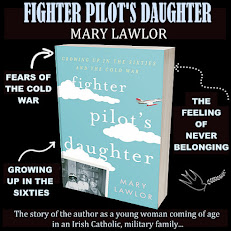
Fighter Pilot’s Daughter: Growing Up in the Sixties and the Cold War tells the story of Mary Lawlor’s dramatic, roving life as a warrior’s child. A family biography and a young woman’s vision of the Cold War, Fighter Pilot’s Daughter narrates the more than many transfers the family made from Miami to California to Germany as the Cold War demanded. Each chapter describes the workings of this traveling household in a different place and time. The book’s climax takes us to Paris in May ’68, where Mary—until recently a dutiful military daughter—has joined the legendary student demonstrations against among other things, the Vietnam War. Meanwhile her father is flying missions out of Saigon for that very same war. Though they are on opposite sides of the political divide, a surprising reconciliation comes years later.

Read sample here.

Fighter Pilot’s Daughter is available at Amazon.

*****

╰┈➤Book Details

  • Genre: Memoir
  • Sub-genre: Women in History / Military Leaders Biography
  • Language:English
  • Pages: 323
  • Paperback ISBN: 978-1442222007
  • Kindle ISBN: 978-1442222014
  • Publisher: Rowman and Littlefield
  • Format: Hardcover, Paperback, Kindle, Audiobook

*****

╰┈➤Here’s What Readers Have To Say!

“Mary Lawlor's memoir, Fighter Pilot's Daughter: Growing Up in the Sixties and the Cold War, is terrifically written. The experience of living in a military family is beautifully brought to life. This memoir shows the pressures on families in the sixties, the fears of the Cold War, and also the love that families had that helped them get through those times, with many ups and downs. It's a story that all of us who are old enough can relate to, whether we were involved or not. The book is so well written. Mary Lawlor shares a story that needs to be written, and she tells it very well.” ―The Jordan Rich Show
 
“Mary Lawlor, in her brilliantly realized memoir, articulates what accountants would call a soft cost, the cost that dependents of career military personnel pay, which is the feeling of never belonging to the specific piece of real estate called home. . . . [T]he real story is Lawlor and her father, who is ensconced despite their ongoing conflict in Lawlor’s pantheon of Catholic saints and Irish presidents, a perfect metaphor for coming of age at a time when rebelling was all about rebelling against the paternalistic society of Cold War America.” ―Stars and Stripes


First Chapter:

 In the 1920s, when Jack was a child, a framed photograph of his father stood in the living room of their house on Richmond Avenue in South Orange, New Jersey. My grandfather, Edmond Vincent Lawlor, had come to the United States in the early years of the twentieth century, when he was barely into his teens. On September 19, 1916, he became a U.S. citizen. Not long after, he signed up for Officers Candidate School at Princeton and got ready to join thousands of others in The World War, later renamed World War I. The picture on the table shows him in uniform, stiff with duty. As a household decoration, it signaled the deep connection between the nation and the family, demonstrated through military service.
Papa, as we called our grandfather, gives a faint smile in the picture.
There’s nothing macho in this expression, no hint he was imagining himself heroic. He was a devout Catholic and would have understood his soldierly commitment as God’s will. Fighting on the side of the Yanks also gave him a chance to show his affection for America. This was the country that had taken him in, given him a job in a powder factory, offered a new life to his mother and aunt.
World War I was still a pulsating memory when Jack was a boy. For him it would have been a murky tale of faraway places and mysterious danger. The photo showed his father on the edge of all this, an adventurer and a stunningly different person from the cheerful, gray-suited insurance salesman who came home every day at six o’clock.
Papa Lawlor at Officers Candidate School near the end of WWI Edmond never went to the war. It ended by the time he finished OCS. But Iremember that picture of him in uniform, there in the many living rooms of my own early years, a reminder that Papa was not only the mild, affable Irishman we loved, but a man who knew how to use a gun, had been ready to expose himself to violence on behalf of our country.
I say Papa smiles in the photo, but when I look at it now the expression isn’t so easy to read. The face is actually pretty blank. You could say it’s a mask, an empty screen hiding Papa’s feelings, even his sense of himself as a Navy ensign. The eyes are aimed slightly to his right, off camera, as if he’s not entirely engaged in the portrait. If you keep looking, movement stirs in his face. It’s in the eyes of the beholder, of course, but he begins to look like he’s ready for something else and can barely stand the still pose. Is this simply his characteristic lack of vanity?
Does he want to get going with the soldiering? Or is he itching to get out of the uniform, go home where he belongs.
As Jack came to the end of his school years, the laughing family and shady streets of South Orange started to look tame. He tried a few semesters at Seton Hall University, not far from home, but his performance was less than impressive. Letters show he was already captured by thoughts of himself far away, across the continent, perhaps the ocean. But he never looked down on his local, New Jersey world. It was the setting of boyhood stories he told us when we were kids. It was the place he gladly returned to after hot summer days in downtown New York, working as a messenger for the Japanese Cotton and Silk Trading Company. South Orange was his mother’s world. It was where Nan Ferris Lawlor presided over his beloved brothers and sisters—“my kin,” as he jokingly called them. In his first uniform, standing on the dappled lawn of the house on Richmond Avenue, he grins at the camera, his arm around her. He looks happy to be so grounded there, and so ready to go away. He wanted adventure. He wanted to go to sea, to learn navigation. And he wanted to fly.
In March 1942 Jack enrolled as a cadet at the U.S. Merchant Marine Academy. Established by Congress in 1938, the Merchant Marine Cadet Corps trained sailors for commercial ships that could convert to military service in times of war. Now, with the demands of World War II pressing, merchant marines were needed for duty in less time than the formal curriculum allowed. Jack spent three months in the class room at the Academy’s temporary facilities on the Chrysler estate in Great Neck, Long Island. Courses included seamanship, cargo handling, maritime engineering, math, and ship construction. He studied hard and did well. Letters home, written in an exuberant voice, show how excited he was to be learning the life of a seaman, getting ready to see the world.
In preparing for a naval science exam in the spring of 1943, he wrote his father, “If I don’t pass it at least I tried. I know you’ll be interested to hear this Dad, knowing how disappointed you were with the time I wasted in Seton Hall. I realize that myself now, Dad, more than ever and I’m going to do my best to make up for it.” He was affectionate with his parents and wrote as if pleasing them mattered a great deal. For all his desire to get away from home and out into the world, his identification with the family was absolute.
Gleeful at what the Merchant Marines were preparing him to do, Jack found talents he didn’t know he had in the seamanship training, especially in navigation. For the signaling course, he had to commit endless codes to memory. He would have to pass a test that required sending eight words per minute in Semaphore and another eight in Morse. “It’s going to be tough,” he complained, “because there is nothing interesting about it. It’s just plain memory work. But you’ve got to know this stuff on board ship so it’s a good thing.”
Practicing as an able bodied seaman was another story. “Yesterday afternoon we shipped an 800 pound anchor over the side to a barge and there were only three of us to move it. Today we had quite a thrill. They sent Tex and me aloft to paint the masts in a boatswain’s swing. Boy oh Boy but you’re away way up when you do that and when we painted the top part and got down to the spar we had to crawl out on our bellies to paint the end of the thing. God I liked to die. That mast was swaying with the ship and me out on the yard that was bending under my weight. I’m so darn tired from hanging on that I can hardly lift the pen. But I think I’ll live.”
With his six-foot frame, good looks, and rough amiability, Jack made friends easily. Time with his new pals was often brief, as the advanced pace of Merchant Marine training meant assignments were given out quickly. In letters home he complained at having to say goodbye. “I made quite a friend with this guy Tex. . . . But he’s due to go home in two weeks. Gosh it’s lousy this way your friends come and go so quickly in a place like this.” As Jack’s first voyage approached, he was glum about the separations. “There are only 4 of us left out of our whole gang since this afternoon, for 3 shipped out then. . . . Boy it really seemed tough saying goodbye to those 3 guys this afternoon and we’re a pretty lonesome bunch tonight.” The letter has a prophetic tone to it. There would be a lot of this in years to come. Jack would soon toughen up, learn to slap the guys on the back and say good-bye fast. He knew he might never see them again, and he stopped writing home about it.
Reading this letter about the three guys shipping out so many decades later, I feel badly for my dad. Then I see mornings on the tarmac when Jack is leaving us for some long-term mission. And the sight of a neighborhood comes up, receding in the back window of our car. Friends, then boyfriends wave good-bye. Of course, for Dad and his remaining pals another kind of loss lurked at the sight of the waiting sea bags and in the last, terse good-byes. Where they were going death lurked right beside the adventures.
On May 11, 1942, he got his shipping papers. Rumors had been circulating that his cohort would have their first orders soon. Jack’s letters are ambivalent about it. Twice he uses the word terrific where terrible should be. A few paragraphs after announcing the news of the shipping papers, he writes, “It seems terrific to think that I’ll be actually leaving home for such a long time. I keep trying to picture what it’s going to be like. I just dread the thought of the dam last day when I have to say so long to you all.” A week later, he and his pals set out by train for San Francisco where they would be assigned to a ship. In the club car with his friend Ray Barrett he penned a note, posted by the porter from Pittsburgh, describing his sad self in not entirely convincing terms: “Well that dreadful day when I had to leave you is almost past and let me tell you the big tough guy who never got homesick isn’t so big and tough any more and this afternoon at Penn Sta he was plenty homesick. But after we fastened up we had a good chicken dinner for $1.65 less 10% for the uniform. I felt much better. But it was terrific leaving you.”
In San Francisco, before reporting for ship duty, he had the time of his life. He and his friends were treated like visiting celebrities. “I’m in the best place in town, the Hotel Francis Drake, and a gal just took my picture. I’ll send you one.” In the same letter he tells them “our picture was in the S.F. Chronicle. I’ll send you one of those too! The S.F. Chamber of Commerceis having a National Maritime Day and we were picked to pose for the paper.” He sent a clipping along, a photo of himself and a fellow cadet in dress uniform, smiling as they explain the details of a model cargo ship bridge to a San Franciscan named Virginia Haley. It’s hard to tell whether the center of the photo is the ship model, Dad’s grin, or Haley’s legs. At the Persian Room on May 21, he laughs at the camera in the company of an unnamed actress in a white pillbox hat. The next night, at Charlie Low’s Forbidden City, a supper club on Sutter Street, he stands beside a local actress, looking awkward but dapper nonetheless. Another night in the Persian Room, Jack
glances at the photographer while talking with Ray Barrett and another friend from the Academy. Over cocktails and smokes, they’re obviously enjoying themselves, but something serious hovers between them. Ray wrote on the inside of the photo sleeve, “We went to the Academy together and now we’re going to sea together. Need I say more than all the luck in the world to you?” Amid the dancing and cocktails and the photographers, they were having a ball. They were also thinking about what was coming next.
He was assigned to the Grace Line’s Santa Clara. “The ship is a corker—it’s big, fast and well armed (Thank God),” he wrote to the family. “Our stateroom was a mess when we first got into it but today we fixed it up and it’s pretty nice. We have plenty of room, our own bath and lots of closet and locker space. There are three of us in the room and we get along swell. The meals are swell and we eat in the officers’ mess. It’s a break being on a troop ship, because the food is always extra good on them and besides they are well protected.” Earlier, still in San Francisco, he had met some of his superiors and written home, “the officers are swell guys and surprisingly young. We are with the third mate tonight and the girls [Jack’s sisters, Ann and Marg] would go nuts over him. We are learning more than I thought it was possible for me to commit to my thick cranium, just through these young fellars. The skipper is only 35. How about that?” In ten weeks they would be back in New York. Jack was out of his head with excitement but mindful of his attachment to home. In a postscript, he notes “I’m damn happy, but a little lonesome.”
By the end of his first year, Jack had been at sea for nine months.
Still he kept in touch with South Orange regularly. He addresses the household as “Dear Home” and signs his letters “Salty.” Expressions of affection intensify as time, distance grow. On the eve of his first trip to the Pacific he wrote: “You have said you were proud of me. Well I’m pretty damn proud to call myself one of you.” At times the words have a faint ring of guilt—for being so far from home, for having a great time at it: “You are the grandest Mother and Dad a fellow could have and I’ll always look forward to the days I can spend with you again.”
Jack was out on a cruise when Edward Haugh, who would soon become his close friend and brother-in-law, entered the Merchant Marine Academy in 1943. Five years later Ed married Frannie’s younger sister, Mary Ellen. Like a mirror opposite of our own family, Mary Ellen and Ed had four sons, more or less our ages. Much later, after my dad and uncle had become experienced seamen and pilots, after they’d seen violent action in war, it was the Haugh boys who learned about the most dramatic events, the violent ones. As girls and even women, we were never told those things. Bits and pieces reached our ears, fragments of stories about crashes and escapes through enemy territory. We would wonder, mystified, about where our father had been, how these things happened, what he felt and did. I imagined veiled scenes in dark jungles, Dad slipping through the high growth, his terrified gaze hunting the perimeter. He would be operating on deadly survival instincts, hungry, thirsty, wet. A specter as frightening as the enemies who missed him, he crept in absolute silence, the blue eyes, like flashlights, pointing the way. Or he was down in the sea, clinging to the wing of a plane, waiting for some helicopter to lift him out. These images came and went whether he was home or away.
During the return cruise to New York in early August, Jack’s exhilaration with life as a Merchant Marine came under the cloud of one particular commander. The man threw his weight around, made his presence felt among the cadets, making them do unnecessary things, just because he could. Jack got in his sights and found himself in a power struggle with a personal charge to it. He restrained himself from telling the guy off when he demanded that a course, checked for accuracy several times already, be backed up with a series of alternative routes—a job that called for meticulous, time consuming calculations.
Jack took a deep breath and performed the useless task but swore he would get out of this man’s clutches. Landed in New York again in September, he and his buddies proceeded to the Merchant Marine office downtown to sign up for another trip out, but the functionary in charge refused to put them together on a different ship. Word had made its way from the dock. Jack and his best friend, George Roper, decided “to hell with them.” As Merchant Marine cadets, they had already been sworn into the Navy on reserve status. The Navy could give them something the academy couldn’t. They could learn to fly. The next day the two of them walked north to the Naval Recruiting Office and enlisted for active duty.
In the Merchant Marines, the cadets had been introduced to the ancient discipline of navigation. Always good at math in school, Jack, George, and my uncle Ed had taken it up like naturals. Mathematical representations were as real to them as the ground itself. Even in retirement, their desks were littered with compasses, rulers, pencils and scraps of paper covered with calculations. The practice of charting seas gave them confidence in moving through watery space, like it was lined and readable as a series of roads. Success at plotting a course at sea, as Uncle Ed explained not long ago, rattled their imaginations. They wondered how it would be to navigate the sky.
In the autumn of 1942, Jack and George began flight school at the Naval air station in New Paltz, New York, north of West Point. Ed came up the following year. Jack’s notes for the first course, in a folder labeled in block print “Aircraft Identification, Mr. Oakley,” show he was already dedicated to learning everything he could about airplanes. In a careful hand he lists “Four main wing and plane relationships,” “Wing Descriptions,” and “Tips.” He copies the markings for Navy and Army aircraft alphabetically. A hand-drawn graph, the boxes neatly ruled, identifies the names of airplanes with their wing and tip configurations; engine and armaments; tail and fuselage surfaces; speed, ceiling and load range. Forty-two different planes appear in the six-page chart.
Photos, cut from catalogs and neatly taped to the notebook pages, show the Grumman G-21, the F4F Wildcat, the Martin PBM-3 Mariner (a “flying boat”), the Vought-Sikorsky OS2U-1 Kingfisher, the SB2U-3 Vindicator (“a dive bomber”), and many others. British planes appear—the Hawker Hurricane IIc (“with bombs slung under the wings”), and the Handley Page Halifax. A page is set aside for Japan’s Kawanishi Type 94 (a bomber for which “no information is available on the location of the bomb bays”); another for Germany’s Dornier DO 17 (“a reconnaissance bomber”) and the infamous Messerschmitts—the ME110 and ME109F.Captions indicate the wing and tail markings and the all-important size, speed, and range specifications. For survival’s sake, Jack would have to get these in his head. Notes in the margins indicate he was memorizing speed, altitude, and bombing capabilities of all the aircraft.
In March 1943, he wrote his father, “I’ve got almost four hours in the air now and I ought to solo in seven or eight, which should be some time this week . . . I’ve got a damn good instructor and he drums those fundamentals into us all the time. I’m due to go upstairs to learn a series of ‘spins.’” Upstairs referred to four thousand feet, a dramatic, new level. The excitement of flying so high, of getting to take the airplane to the limits of its capacity, continues a few days later: “Boy those spins are something. We climbed to 4000, cut the motor and turner her nose straight up and put the rudder hard left and bingo! Down she goes nose first spinning like a top. We do two complete spins and come out of it.”
Shortly after, he made his first solo. The plane was an Aeronca Defender. He told his brother Edmond about it later, but no description of this prime moment appears in the letters. Soon he sent his mother an account of what flying alone was like. “Walt, my Instructor, let me go out over our area alone yesterday afternoon for a whole hour.
You can’t see the area from the field so I had quite a time for myself. First I practiced high work and went up over the cloudbank at about 7,000 feet. You never saw anything so beautiful in all your life just you the plane and the sky and those big white pillows below you. Super stuff.” Already he felt confident enough with the aircraft to start fooling around. “After that, I went down very low and practiced forced landings and made sure the fields were pastures and Boy you ought to see those dam old cows run. When I realized how much fun it was I tried dive bombing them and hot dog if ‘Bossie’ didn’t dam near give birth to a goat. Oh you should of seen them go—” He signs the letter “Orville Wright.”
Training continued into the summer of 1943 at Chapel Hill, North Carolina, where he started doing acrobatic hops; then at Bunker Hill, Indiana, where his enthusiasm grew explosive. “The flying is really terrific,” he wrote his mother and father. “There are three stages you have to get through. First you have A stage, that’s just safe for solo and then B stage, that’s ‘S’ turns and slips to circles and wingovers. Then in C stage you really start flying. That’s acrobatics and night flying and those acrobatics include everything, slow rolls, snap rolls, Immelman’s and inverted spins and falling leaves and every other tough one you can think of.”
During those months at Chapel Hill, Jack went through a rigorous athletic program, including a week each of track, swimming, football and boxing. The cadets were graded for each sport. Competition for strong marks was high. On August 5 he wrote his parents, “I got my boxing marks yesterday and today. I didn’t make out too good yesterday. I lost my fight but today I made up for it. I won by a T.K.O. (that means they had to stop the fight because the guy I was fighting was pretty badly cut up).” Without another word about this, he moves on to his successes in football. He had made the battalion squad, a first for his platoon. His father must have written expressing concern about the August 5 account of leaving his boxing opponent “pretty badly cut up.”
On the thirty-first, Jack wrote, “You sounded a little worried about my reaction to that fight I had. Well it’s O.K. Fact is I’ve made pretty good friends with the guy since and he wasn’t hurt too much anyway.”
This is the first evidence of Jack’s capacity for combat. The athletic schedule at Chapel Hill was aimed at sharpening reflexes for just this purpose. In late August he described to his mother how wrestling was simultaneously training in hand to hand combat: “This hand to hand is the coldest stuff man ever thought up. It was explained to us this morning as the ways of quickly killing or disabling permanently a man with only the weapons God gave us. We’re being taught to gouge out a man’s eyes and bite off his ears and bite into his jugular vein in his throat and every conceivable dirty stunt in the books.” If the “dirty stunts” seemed repellent to Jack and the detailed description a way of absorbing the shock, they must have been nothing short of shocking to his mother.
Why he would submit this information to her is something of a mystery.
Sharing scenes of violence with women was not a practice he would continue. During these years as a young flyer, everybody in the family served in the crucial role of audience for his adventures.
Jack’s preferred vision of military life at this point was far and away a vision of flying, of trying out the heights and lows, the angles and spins an airplane could take. Ground combat was distasteful and not for him.
In June of 1944, he earned his wings at the Naval air station in Pensacola, Florida. At this point, a cadet could chose to continue with the Navy or to shift to the Marine Corps, and Jack chose the Marines. That fall he found himself on the west coast again, this time in southern California.
At the Marine Corps air station in El Toro he underwent a combat conditioning course. “You would think we were going through infantry school instead of being aviators. It’s very much similar to Chapel Hill only a lot tougher. We start at the crack of dawn and do close order drill, exercises and bayonet drill until sundown. And then to bed and no kidding I’m there by seven. It’s doing good, I guess.”
But El Toro meant more flight school too. By now he was tired of being a student. “Well here we are again,” he wrote in early January of 1945, “back in school. How do you like it? Gee I haven’t done a damn thing but go to school since the beginning of the damn war. But this time I think I’ve got something because these jokers say that they are going to teach us how to fly every airplane the Navy uses, from primary trainers to the big 4 engined flying boats. This month alone we will be flying Avengers, Hellcats, Hell divers.” He had been through seventy two weeks of flight training, almost a year and a half as a student. As a professional aviator, he would go back to “school” periodically to learn the technology of new aircraft. Later training, however, was more about refining skills he already had, skills that would eventually come to be recognized as those of a master aviator.
Jack had been away from home for some time now. He wrote that he missed the holidays with the family. “I don’t expect we’ll get a transcontinental for a couple of months yet, but I’ll get there by gosh. If they won’t send me over seas I’ll get there by hook or crook.” Aware of the ambivalence in his phrasing and the muddiness—won’t instead of don’t and the open-ended meaning of there—about what he really wanted next, to go home or “overseas,” which meant to the war, he adds in parenthesis, “to New York I mean.” In spite of Jack’s exhaustion with being a student, it’s pretty clear as he virtually chants the names of the airplanes he is about to get his hands on that what he wants most is to fly and fly some more. The implication is strong that he wanted not so much to go home but to get further away.
In all Jack’s letters written from the Merchant Marine Academy, from Navy flight school, and Marine Corps training, references to the Catholic religion in which he was raised are sparse and formal. From Navy pre-flight school in Chapel Hill, North Carolina in September 1943 he described a field mass he attended at the base stadium. It was a solemn high pontifical mass, “very pretty and very impressive . . . I sang in the choir and we sang the mass of St. Basil and it sounded pretty good.” But the event is also memorable because his girlfriend Ruth was visiting from New Jersey. They’d been engaged since before he’d left the Merchant Marines, but the relationship wouldn’t survive the long separation to come.
Later that month the base chaplain, Father Sullivan, asked Jack to manage a fund raising campaign with his outgoing battalion for the construction of a church. Jack spent a week with a friend giving “pep talks” and canvassing. The priest “almost jumped out of his pants” when they handed over $444.60. Other stories sent home remind his parents that he’s still a good, practicing Catholic son; but none of his writing expresses a deep or conscientious sense of devotion. In a postscript, he notes, “The chaplain is a grand guy. Have been to Sacraments” and “Still taking pills and saying Hail Marys.”
If pressed, Jack would undoubtedly have declared the whole project in which he was engaged—learning to be a warrior for the good guys—the deepest sacred duty he could perform. It was the sort of credo he would maintain throughout his military career. God, Christ, and the Virgin seemed to loom for him in a distant sphere. Signs of their benevolence or wrath might be legible in this-world phenomena, but they existed elsewhere. Although he kept an image of Our Lady of Loretto—patroness of aviators—in the cockpit with him, it wasn’t until after retirement that he showed a personal, more intimate connection with Catholicism. Maybe it was there in him earlier, but the letters suggest that for the young pilot, the more abstract, the more formal his religion, the better it would work for him.
In May of 1945 he finally set out for the war, to the site of one of the bloodiest conflicts, Okinawa. Assigned to Marine Fighter Squadron 222 of the Second Marine Air Wing, he left San Diego on a troop transport.
He had been waiting for this, for the chance to get beyond the dress rehearsals of training to the sites of real action. Excitement beat like a drum. He knew, of course, what horror lay ahead. The terror was fuel, already sharpening his senses.
The well-ordered life at sea, like the round of days on the base, held up a steady, familiar, world. The repetition of chores, drills, and meals flattened shipboard experience. Behind the lulling rhythms, however, an eerie, Melvillian, spell dragged along. One hot day near New Guinea, when they couldn’t take looking at the gunmetal and the horizon anymore, Jack and a few others climbed over the edge for a swim.
Shortly after, the voice of the commander boomed from the deck, ordering them back on board. Reluctantly but quickly they did as he said. The officer walked them across deck to the opposite side of the ship and pointed into the water. It was boiling with hammerhead sharks.
A “shark shooter,” as Uncle Ed Haugh told me, would normally be stationed at a lookout point high above the deck when sailors were swimming in Pacific waters. Protecting the vulnerable crew, the shooter kept a close eye off the gunwales, ready to fire at any moment. If this protection was in place, it didn’t dispel the commander’s terror at sight of the enormous, T-shaped fish, thronging too close to the splashing men.
The hammerhead shark story was in our heads, told more than once, so vivid was it in Dad’s memory. He was a good storyteller. He knew how to pace the action, when to pause, when to raise and lower his voice. Making a collective character of the swimmers, he showed with wide eyes and eager shoulders how dangerously naïve they were. The commander, deep voiced and rigid, was right, he told us, not because the hammerheads proved him to be, but because he was the commander. With loose-minded people like his younger self to teach and supervise, the commander had to convey that his word, his order, was reason in itself. Jack’s heart was not revolting now, as it had to the arbitrary power of the Merchant Marine officer in the summer of 1942. He had grown up, become a professional; and the wartime context demanded that everybody do precisely as they were told. The scene looks ominously symbolic of the enemy waiting over the horizon, a threat that hadn’t crossed the threshold of visibility for Jack quite yet. But to our ears as children, the episode was like an allegory of the horrible things that could happen if you chose not to follow your leaders, whether they were parents, or teachers, or ship commanders. Outside the boundaries of our ruled lives, nature and the world’s violent passions came snapping at your heels. Better to stay on the boat, as Chef repeats in Apocalypse Now, his voice mechanical, dehumanized with fear.
In all those years of sailing, flying, fighting and bombing far from home, pitched against nature and other people, was my father on the boat or off it? Following orders, he kept his place. He knew to stay near the boat and climb back aboard when commanded. But in later years he would often have to operate as an irregular, out of anybody’s reach, untraceable, courting danger. In this sense he seemed regularly off the boat. And that meant he was unreachable for us, at home, too. Being off the boat was at some level a choice for Jack, like it is for Captain Willard, just returned to Vietnam at the beginning of Apocalypse Now, describing his feelings about home: “When I was here, I wanted to be there; when I was there, all I could think of was getting back into the jungle.”
VMF222 would be credited with shooting down fifty-three Japanese planes during the Battle of Okinawa. Jack flew the F4U Corsair, a carrier-based fighter aircraft he’d been trained to operate at El Toro.
The Corsair was armed with Browning machine guns on the wings. It could shoot missiles and drop bombs.
The Battle of Okinawa lasted for three months, until May 1945. At this point, the U.S. forces had established bases to be used as launch sites for a major attack on the Japanese mainland. The plan was scrapped, of course, when the atom bombs were dropped on Hiroshima and Nagasaki; but the bases remained in place. Jack and his fellow pilots lived in improvised quarters—tents and later quonset huts—not far from the airfield at Awase.
From February until May of 1946, the war now over, Jack was as signed to “Special Service” with the Fourth Marine Wing. This meant duty in Northern China. Among Dad’s medals is a long yellow bar with a red stripe at each end, the China Service medal. Marines had been posted to China since September 1945, helping accept the surrender of Japanese forces. The situation was complicated by the civil war that was building between Chang Kai-shek’s central government and the expanding Communist movement under Mao Tse Tung. Stalin, still America’s ally, was supporting Mao. The United States hadn’t taken an overt military position in this struggle, although the hope was that Chang would prevail. For ordinary marines on duty in China, the scene was sometimes difficult to read.
Jack was housed in U.S. facilities at Tsingtao, on the coast southeast of Beijing. He and other marines shared the rough quarters with foreign nationals posted on commercial and diplomatic missions since before the war, and with members of the United Nations Relief and Rehabilitation Administration. (The UNRR was formed in 1943 by Roosevelt; the “United Nations” were the WWII Allies. The mission was to provide economic aid and relief for nations damaged in WWII.)
Among the international community in Tsingtao, Jack met a Russian woman named Vlada, who he went out with a few times, but either he decided for himself or he was told to stop seeing her. Dating a Soviet citizen had become a problem, and Jack did as he was told. One night Vlada came knocking at his BOQ door. He didn’t answer. She knocked louder and shouted into the night, “It is I, Vlada.” He still didn’t answer.
Eventually she went away. As Dad told the story, it was clear he thought it was funny. He did a comic imitation of Vlada’s accented, dramatic English. It’s hard to know if he was laughing at the time. My sisters and I never thought to ask this question. Were her antics laughable? Or had he distanced himself from her anyway, before the new rule came about, because she was demanding, too serious about him? Did Vlada’s foreignness mean he didn’t need to take her seriously, whether she was funny or not? I think of Vlada, wonder what she was going through that night. Who had she thought she’d found in Jack? What did she think, walking away from his door? Did she remember him for long? And what of Jack in his own eyes? Did he see himself still as a gleeful young pilot, ready to leap the oceans, explore jungles continents away from South Orange? Or had he grown some armor he hadn’t had before the war, a toughness about the heart that would recede and then strengthen again in the tough years to come? If Vlada could be dismissed with a laugh, how ready was he to open his heart seriously to anybody—and to any woman—backhome? 


About the Author:


Mary Lawlor is author of a memoir, Fighter Pilot’s Daughter: Growing Up in the Sixties and the Cold War (Bloomsbury 2015) and two books of cultural criticism, Recalling the Wild: Naturalism and the Closing of the American West (Rutgers UP 2000) and Public Native America (Rutgers UP 2006). She studied at the American University in Paris, the University of Maryland, and New York University. She divides her time between Easton, Pennsylvania and Gaucin, Spain. Her novel, The Translators, is set in 12th century Spain and fictionalizes the experiences of Robert of Ketton, first translator of the Koran into Latin. She hopes to see it out next year. In the meantime, she has started a second novel, The Women’s Hospital, set in 18th century Spain and inspired by the life story of an Irish woman whose family moved to Cádiz, escaping English oppression in their own country.

╰┈➤ You can visit her website at https://www.marylawlor.net/.

Connect with her on social media at:

╰┈➤ Facebook: https://www.facebook.com/mary.lawlor.186/

Monday, October 6, 2025

First Chapter: Fighter Pilot's Daughter by Mary Lawlor

9:00 PM 0 Comments


Title: Fighter Pilot’s Daughter: Growing Up in the Sixties and the Cold War

Author: Mary Lawlor

Publisher: Rowman and Littlefield

Pages: 323

Genre: Memoir

Fighter Pilot’s Daughter: Growing Up in the Sixties and the Cold War tells the story of Mary Lawlor’s dramatic, roving life as a warrior’s child. A family biography and a young woman’s vision of the Cold War, Fighter Pilot’s Daughter narrates the more than many transfers the family made from Miami to California to Germany as the Cold War demanded. Each chapter describes the workings of this traveling household in a different place and time. The book’s climax takes us to Paris in May ’68, where Mary—until recently a dutiful military daughter—has joined the legendary student demonstrations against among other things, the Vietnam War. Meanwhile her father is flying missions out of Saigon for that very same war. Though they are on opposite sides of the political divide, a surprising reconciliation comes years later.

Fighter Pilot’s Daughter is available at Amazon.

Here’s what reviewers are saying about Fighter Pilot’s Daughter!

“Mary Lawlor’s memoir, Fighter Pilot’s Daughter: Growing Up in the Sixties and the Cold War, is terrifically written. The experience of living in a military family is beautifully brought to life. This memoir shows the pressures on families in the sixties, the fears of the Cold War, and also the love that families had that helped them get through those times, with many ups and downs. It’s a story that all of us who are old enough can relate to, whether we were involved or not. The book is so well written. Mary Lawlor shares a story that needs to be written, and she tells it very well.”

―The Jordan Rich Show

“Mary Lawlor, in her brilliantly realized memoir, articulates what accountants would call a soft cost, the cost that dependents of career military personnel pay, which is the feeling of never belonging to the specific piece of real estate called home. . . . [T]he real story is Lawlor and her father, who is ensconced despite their ongoing conflict in Lawlor’s pantheon of Catholic saints and Irish presidents, a perfect metaphor for coming of age at a time when rebelling was all about rebelling against the paternalistic society of Cold War America.”

―Stars and Stripes

First Chapter:

In the 1920s, when Jack was a child, a framed photograph of his father stood in the living room of their house on Richmond Avenue in South Orange, New Jersey. My grandfather, Edmond Vincent Lawlor, had
come to the United States in the early years of the twentieth century, when he was barely into his teens. On September 19, 1916, he became a U.S. citizen. Not long after, he signed up for Officers Candidate
School at Princeton and got ready to join thousands of others in The World War, later renamed World War I. The picture on the table shows him in uniform, stiff with duty. As a household decoration, it signaled the deep connection between the nation and the family, demonstrated through military service.
Papa, as we called our grandfather, gives a faint smile in the picture.
There’s nothing macho in this expression, no hint he was imagining himself heroic. He was a devout Catholic and would have understood his soldierly commitment as God’s will. Fighting on the side of the
Yanks also gave him a chance to show his affection for America. This was the country that had taken him in, given him a job in a powder factory, offered a new life to his mother and aunt.
World War I was still a pulsating memory when Jack was a boy. For him it would have been a murky tale of faraway places and mysterious danger. The photo showed his father on the edge of all this, an adventurer and a stunningly different person from the cheerful, gray-suited insurance salesman who came home every day at six o’clock.
Papa Lawlor at Officers Candidate School near the end of WWI Edmond never went to the war. It ended by the time he finished OCS. But Iremember that picture of him in uniform, there in the many living rooms of my own early years, a reminder that Papa was not only the mild, affable Irishman we loved, but a man who knew how to use a gun, had been ready to expose himself to violence on behalf of our country.
I say Papa smiles in the photo, but when I look at it now the expression isn’t so easy to read. The face is actually pretty blank. You could say it’s a mask, an empty screen hiding Papa’s feelings, even his sense of
himself as a Navy ensign. The eyes are aimed slightly to his right, off camera, as if he’s not entirely engaged in the portrait. If you keep looking, movement stirs in his face. It’s in the eyes of the beholder, of
course, but he begins to look like he’s ready for something else and can barely stand the still pose. Is this simply his characteristic lack of vanity?
Does he want to get going with the soldiering? Or is he itching to get out of the uniform, go home where he belongs.
As Jack came to the end of his school years, the laughing family and shady streets of South Orange started to look tame. He tried a few semesters at Seton Hall University, not far from home, but his performance was less than impressive. Letters show he was already captured by thoughts of himself far away, across the continent, perhaps the ocean. But he never looked down on his local, New Jersey world. It was the setting of boyhood stories he told us when we were kids. It was the place he gladly returned to after hot summer days in downtown New York, working as a messenger for the Japanese Cotton and Silk Trading Company. South Orange was his mother’s world. It was where Nan Ferris Lawlor presided over his beloved brothers and sisters—“my kin,” as he jokingly called them. In his first uniform, standing on the dappled lawn of the house on Richmond Avenue, he grins at the camera, his arm around her. He looks happy to be so grounded there, and so ready to go away. He wanted adventure. He wanted to go to sea, to learn navigation. And he wanted to fly.
In March 1942 Jack enrolled as a cadet at the U.S. Merchant Marine Academy. Established by Congress in 1938, the Merchant Marine Cadet Corps trained sailors for commercial ships that could convert to
military service in times of war. Now, with the demands of World War II pressing, merchant marines were needed for duty in less time than the formal curriculum allowed. Jack spent three months in the class
room at the Academy’s temporary facilities on the Chrysler estate in Great Neck, Long Island. Courses included seamanship, cargo handling, maritime engineering, math, and ship construction. He studied
hard and did well. Letters home, written in an exuberant voice, show how excited he was to be learning the life of a seaman, getting ready to see the world.
In preparing for a naval science exam in the spring of 1943, he wrote his father, “If I don’t pass it at least I tried. I know you’ll be interested to hear this Dad, knowing how disappointed you were with the time I wasted in Seton Hall. I realize that myself now, Dad, more than ever and I’m going to do my best to make up for it.” He was affectionate with his parents and wrote as if pleasing them mattered a great deal. For all
his desire to get away from home and out into the world, his identification with the family was absolute.
Gleeful at what the Merchant Marines were preparing him to do, Jack found talents he didn’t know he had in the seamanship training, especially in navigation. For the signaling course, he had to commit
endless codes to memory. He would have to pass a test that required sending eight words per minute in Semaphore and another eight in Morse. “It’s going to be tough,” he complained, “because there is nothing interesting about it. It’s just plain memory work. But you’ve got to know this stuff on board ship so it’s a good thing.”
Practicing as an able bodied seaman was another story. “Yesterday afternoon we shipped an 800 pound anchor over the side to a barge and there were only three of us to move it. Today we had quite a thrill. They sent Tex and me aloft to paint the masts in a boatswain’s swing. Boy oh Boy but you’re away way up when you do that and when we painted the top part and got down to the spar we had to crawl out on our bellies to paint the end of the thing. God I liked to die. That mast was swaying with the ship and me out on the yard that was bending under my weight. I’m so darn tired from hanging on that I can hardly lift the pen. But I think I’ll live.”
With his six-foot frame, good looks, and rough amiability, Jack made friends easily. Time with his new pals was often brief, as the advanced pace of Merchant Marine training meant assignments were given out
quickly. In letters home he complained at having to say goodbye. “I made quite a friend with this guy Tex. . . . But he’s due to go home in two weeks. Gosh it’s lousy this way your friends come and go so quickly
in a place like this.” As Jack’s first voyage approached, he was glum about the separations. “There are only 4 of us left out of our whole gang since this afternoon, for 3 shipped out then. . . . Boy it really seemed
tough saying goodbye to those 3 guys this afternoon and we’re a pretty lonesome bunch tonight.” The letter has a prophetic tone to it. There would be a lot of this in years to come. Jack would soon toughen up, learn to slap the guys on the back and say good-bye fast. He knew he might never see them again, and he stopped writing home about it.
Reading this letter about the three guys shipping out so many decades later, I feel badly for my dad. Then I see mornings on the tarmac when Jack is leaving us for some long-term mission. And the sight of a neighborhood comes up, receding in the back window of our car. Friends, then boyfriends wave good-bye. Of course, for Dad and his remaining pals another kind of loss lurked at the sight of the waiting
sea bags and in the last, terse good-byes. Where they were going death lurked right beside the adventures.
On May 11, 1942, he got his shipping papers. Rumors had been circulating that his cohort would have their first orders soon. Jack’s letters are ambivalent about it. Twice he uses the word terrific where
terrible should be. A few paragraphs after announcing the news of the shipping papers, he writes, “It seems terrific to think that I’ll be actually leaving home for such a long time. I keep trying to picture what it’s going to be like. I just dread the thought of the dam last day when I have to say so long to you all.” A week later, he and his pals set out by train for San Francisco where they would be assigned to a ship. In the club car with his friend Ray Barrett he penned a note, posted by the porter from Pittsburgh, describing his sad self in not entirely convincing terms: “Well that dreadful day when I had to leave you is almost past and let me tell you the big tough guy who never got homesick isn’t so big and tough any more and this afternoon at Penn Sta he was plenty homesick. But after we fastened up we had a good chicken dinner for $1.65 less 10% for the uniform. I felt much better. But it was terrific leaving you.”
In San Francisco, before reporting for ship duty, he had the time of his life. He and his friends were treated like visiting celebrities. “I’m in the best place in town, the Hotel Francis Drake, and a gal just took my picture. I’ll send you one.” In the same letter he tells them “our picture was in the S.F. Chronicle. I’ll send you one of those too! The S.F. Chamber of Commerceis having a National Maritime Day and we were picked to pose for the paper.” He sent a clipping along, a photo of himself and a fellow cadet in dress uniform, smiling as they explain the details of a model cargo ship bridge to a San Franciscan named Virginia Haley. It’s hard to tell whether the center of the photo is the ship model, Dad’s grin, or Haley’s legs. At the Persian Room on May 21, he laughs at the camera in the company of an unnamed actress in a white pillbox hat. The next night, at Charlie Low’s Forbidden City, a supper club on Sutter Street, he stands beside a local actress, looking awkward but dapper nonetheless. Another night in the Persian Room, Jack
glances at the photographer while talking with Ray Barrett and another friend from the Academy. Over cocktails and smokes, they’re obviously enjoying themselves, but something serious hovers between them. Ray wrote on the inside of the photo sleeve, “We went to the Academy together and now we’re going to sea together. Need I say more than all the luck in the world to you?” Amid the dancing and cocktails and the photographers, they were having a ball. They were also thinking about what was coming next.
He was assigned to the Grace Line’s Santa Clara. “The ship is a corker—it’s big, fast and well armed (Thank God),” he wrote to the family. “Our stateroom was a mess when we first got into it but today we fixed it up and it’s pretty nice. We have plenty of room, our own bath and lots of closet and locker space. There are three of us in the room and we get along swell. The meals are swell and we eat in the officers’ mess. It’s a break being on a troop ship, because the food is always extra good on them and besides they are well protected.” Earlier, still in San Francisco, he had met some of his superiors and written home, “the officers are swell guys and surprisingly young. We are with the third mate tonight and the girls [Jack’s sisters, Ann and Marg] would go nuts over him. We are learning more than I thought it was possible for me to commit to my thick cranium, just through these young fellars. The skipper is only 35. How about that?” In ten weeks they would be back in New York. Jack was out of his head with excitement but mindful of his attachment to home. In a postscript, he notes “I’m damn happy, but a little lonesome.”
By the end of his first year, Jack had been at sea for nine months.
Still he kept in touch with South Orange regularly. He addresses the household as “Dear Home” and signs his letters “Salty.” Expressions of affection intensify as time, distance grow. On the eve of his first trip to
the Pacific he wrote: “You have said you were proud of me. Well I’m pretty damn proud to call myself one of you.” At times the words have a faint ring of guilt—for being so far from home, for having a great time
at it: “You are the grandest Mother and Dad a fellow could have and I’ll always look forward to the days I can spend with you again.”
Jack was out on a cruise when Edward Haugh, who would soon become his close friend and brother-in-law, entered the Merchant Marine Academy in 1943. Five years later Ed married Frannie’s younger
sister, Mary Ellen. Like a mirror opposite of our own family, Mary Ellen and Ed had four sons, more or less our ages. Much later, after my dad and uncle had become experienced seamen and pilots, after they’d
seen violent action in war, it was the Haugh boys who learned about the most dramatic events, the violent ones. As girls and even women, we were never told those things. Bits and pieces reached our ears, fragments of stories about crashes and escapes through enemy territory. We would wonder, mystified, about where our father had been, how these things happened, what he felt and did. I imagined veiled scenes in dark jungles, Dad slipping through the high growth, his terrified gaze hunting the perimeter. He would be operating on deadly survival instincts, hungry, thirsty, wet. A specter as frightening as the enemies who missed him, he crept in absolute silence, the blue eyes, like flashlights, pointing the way. Or he was down in the sea, clinging to the wing of a plane, waiting for some helicopter to lift him out. These images came and went whether he was home or away.
During the return cruise to New York in early August, Jack’s exhilaration with life as a Merchant Marine came under the cloud of one particular commander. The man threw his weight around, made his presence felt among the cadets, making them do unnecessary things, just because he could. Jack got in his sights and found himself in a power struggle with a personal charge to it. He restrained himself from
telling the guy off when he demanded that a course, checked for accuracy several times already, be backed up with a series of alternative routes—a job that called for meticulous, time consuming calculations.
Jack took a deep breath and performed the useless task but swore he would get out of this man’s clutches. Landed in New York again in September, he and his buddies proceeded to the Merchant Marine
office downtown to sign up for another trip out, but the functionary in charge refused to put them together on a different ship. Word had made its way from the dock. Jack and his best friend, George Roper, decided “to hell with them.” As Merchant Marine cadets, they had already been sworn into the Navy on reserve status. The Navy could give them something the academy couldn’t. They could learn to fly. The next day the two of them walked north to the Naval Recruiting Office
and enlisted for active duty.
In the Merchant Marines, the cadets had been introduced to the ancient discipline of navigation. Always good at math in school, Jack, George, and my uncle Ed had taken it up like naturals. Mathematical
representations were as real to them as the ground itself. Even in retirement, their desks were littered with compasses, rulers, pencils and scraps of paper covered with calculations. The practice of charting seas
gave them confidence in moving through watery space, like it was lined and readable as a series of roads. Success at plotting a course at sea, as Uncle Ed explained not long ago, rattled their imaginations. They wondered how it would be to navigate the sky.
In the autumn of 1942, Jack and George began flight school at the Naval air station in New Paltz, New York, north of West Point. Ed came up the following year. Jack’s notes for the first course, in a folder la
beled in block print “Aircraft Identification, Mr. Oakley,” show he was already dedicated to learning everything he could about airplanes. In a careful hand he lists “Four main wing and plane relationships,” “Wing Descriptions,” and “Tips.” He copies the markings for Navy and Army aircraft alphabetically. A hand-drawn graph, the boxes neatly ruled, identifies the names of airplanes with their wing and tip configurations; engine and armaments; tail and fuselage surfaces; speed, ceiling and load range. Forty-two different planes appear in the six-page chart.
Photos, cut from catalogs and neatly taped to the notebook pages, show the Grumman G-21, the F4F Wildcat, the Martin PBM-3 Mariner (a “flying boat”), the Vought-Sikorsky OS2U-1 Kingfisher, the SB2U-3
Vindicator (“a dive bomber”), and many others. British planes appear—the Hawker Hurricane IIc (“with bombs slung under the wings”), and the Handley Page Halifax. A page is set aside for Japan’s Kawanishi
Type 94 (a bomber for which “no information is available on the location of the bomb bays”); another for Germany’s Dornier DO 17 (“a reconnaissance bomber”) and the infamous Messerschmitts—the ME
110 and ME109F.Captions indicate the wing and tail markings and the all-important size, speed, and range specifications. For survival’s sake, Jack would have to get these in his head. Notes in the margins indicate he was memorizing speed, altitude, and bombing capabilities of all the aircraft.
In March 1943, he wrote his father, “I’ve got almost four hours in the air now and I ought to solo in seven or eight, which should be some time this week . . . I’ve got a damn good instructor and he drums those


fundamentals into us all the time. I’m due to go upstairs to learn a series of ‘spins.’” Upstairs referred to four thousand feet, a dramatic, new level. The excitement of flying so high, of getting to take the airplane to the limits of its capacity, continues a few days later: “Boy those spins are something. We climbed to 4000, cut the motor and turner her nose straight up and put the rudder hard left and bingo! Down she goes nose first spinning like a top. We do two complete spins and come out of it.”
Shortly after, he made his first solo. The plane was an Aeronca Defender. He told his brother Edmond about it later, but no description of this prime moment appears in the letters. Soon he sent his
mother an account of what flying alone was like. “Walt, my Instructor, let me go out over our area alone yesterday afternoon for a whole hour.
You can’t see the area from the field so I had quite a time for myself. First I practiced high work and went up over the cloudbank at about 7,000 feet. You never saw anything so beautiful in all your life just you
the plane and the sky and those big white pillows below you. Super stuff.” Already he felt confident enough with the aircraft to start fooling around. “After that, I went down very low and practiced forced landings and made sure the fields were pastures and Boy you ought to see those dam old cows run. When I realized how much fun it was I tried dive bombing them and hot dog if ‘Bossie’ didn’t dam near give birth to a goat. Oh you should of seen them go—” He signs the letter “Orville Wright.”
Training continued into the summer of 1943 at Chapel Hill, North Carolina, where he started doing acrobatic hops; then at Bunker Hill, Indiana, where his enthusiasm grew explosive. “The flying is really terrific,” he wrote his mother and father. “There are three stages you have to get through. First you have A stage, that’s just safe for solo and then B stage, that’s ‘S’ turns and slips to circles and wingovers. Then in C stage you really start flying. That’s acrobatics and night flying and those acrobatics include everything, slow rolls, snap rolls, Immelman’s and inverted spins and falling leaves and every other tough one you can
think of.”
During those months at Chapel Hill, Jack went through a rigorous athletic program, including a week each of track, swimming, football and boxing. The cadets were graded for each sport. Competition for strong marks was high. On August 5 he wrote his parents, “I got my boxing marks yesterday and today. I didn’t make out too good yesterday. I lost my fight but today I made up for it. I won by a T.K.O. (that means they had to stop the fight because the guy I was fighting was pretty badly cut up).” Without another word about this, he moves on to his successes in football. He had made the battalion squad, a first for his
platoon. His father must have written expressing concern about the August 5 account of leaving his boxing opponent “pretty badly cut up.”
On the thirty-first, Jack wrote, “You sounded a little worried about my reaction to that fight I had. Well it’s O.K. Fact is I’ve made pretty good friends with the guy since and he wasn’t hurt too much anyway.”
This is the first evidence of Jack’s capacity for combat. The athletic schedule at Chapel Hill was aimed at sharpening reflexes for just this purpose. In late August he described to his mother how wrestling was
simultaneously training in hand to hand combat: “This hand to hand is the coldest stuff man ever thought up. It was explained to us this morning as the ways of quickly killing or disabling permanently a man with
only the weapons God gave us. We’re being taught to gouge out a man’s eyes and bite off his ears and bite into his jugular vein in his throat and every conceivable dirty stunt in the books.” If the “dirty stunts” seemed repellent to Jack and the detailed description a way of absorbing the shock, they must have been nothing short of shocking to his mother.
Why he would submit this information to her is something of a mystery.
Sharing scenes of violence with women was not a practice he would continue. During these years as a young flyer, everybody in the family served in the crucial role of audience for his adventures.
Jack’s preferred vision of military life at this point was far and away a vision of flying, of trying out the heights and lows, the angles and spins an airplane could take. Ground combat was distasteful and not for him.
In June of 1944, he earned his wings at the Naval air station in Pensacola, Florida. At this point, a cadet could chose to continue with the Navy or to shift to the Marine Corps, and Jack chose the Marines. That fall he found himself on the west coast again, this time in southern California.
At the Marine Corps air station in El Toro he underwent a combat conditioning course. “You would think we were going through infantry school instead of being aviators. It’s very much similar to Chapel Hill
only a lot tougher. We start at the crack of dawn and do close order drill, exercises and bayonet drill until sundown. And then to bed and no kidding I’m there by seven. It’s doing good, I guess.”
But El Toro meant more flight school too. By now he was tired of being a student. “Well here we are again,” he wrote in early January of 1945, “back in school. How do you like it? Gee I haven’t done a damn
thing but go to school since the beginning of the damn war. But this time I think I’ve got something because these jokers say that they are going to teach us how to fly every airplane the Navy uses, from primary trainers to the big 4 engined flying boats. This month alone we will be flying Avengers, Hellcats, Hell divers.” He had been through seventy two weeks of flight training, almost a year and a half as a student. As a professional aviator, he would go back to “school” periodically to learn the technology of new aircraft. Later training, however, was more about refining skills he already had, skills that would eventually come to be recognized as those of a master aviator.
Jack had been away from home for some time now. He wrote that he missed the holidays with the family. “I don’t expect we’ll get a transcontinental for a couple of months yet, but I’ll get there by gosh. If they
won’t send me over seas I’ll get there by hook or crook.” Aware of the ambivalence in his phrasing and the muddiness—won’t instead of don’t and the open-ended meaning of there—about what he really wanted next, to go home or “overseas,” which meant to the war, he adds in parenthesis, “to New York I mean.” In spite of Jack’s exhaustion with being a student, it’s pretty clear as he virtually chants the names of the airplanes he is about to get his hands on that what he wants most is to fly and fly some more. The implication is strong that he wanted not so much to go home but to get further away.
In all Jack’s letters written from the Merchant Marine Academy, from Navy flight school, and Marine Corps training, references to the Catholic religion in which he was raised are sparse and formal. From Navy pre-flight school in Chapel Hill, North Carolina in September 1943 he described a field mass he attended at the base stadium. It was a solemn high pontifical mass, “very pretty and very impressive . . . I sang
in the choir and we sang the mass of St. Basil and it sounded pretty good.” But the event is also memorable because his girlfriend Ruth was visiting from New Jersey. They’d been engaged since before he’d left the Merchant Marines, but the relationship wouldn’t survive the long separation to come.
Later that month the base chaplain, Father Sullivan, asked Jack to manage a fund raising campaign with his outgoing battalion for the construction of a church. Jack spent a week with a friend giving “pep
talks” and canvassing. The priest “almost jumped out of his pants” when they handed over $444.60. Other stories sent home remind his parents that he’s still a good, practicing Catholic son; but none of his writing
expresses a deep or conscientious sense of devotion. In a postscript, he notes, “The chaplain is a grand guy. Have been to Sacraments” and “Still taking pills and saying Hail Marys.”
If pressed, Jack would undoubtedly have declared the whole project in which he was engaged—learning to be a warrior for the good guys—the deepest sacred duty he could perform. It was the sort of credo he
would maintain throughout his military career. God, Christ, and the Virgin seemed to loom for him in a distant sphere. Signs of their benevolence or wrath might be legible in this-world phenomena, but they
existed elsewhere. Although he kept an image of Our Lady of Loretto—patroness of aviators—in the cockpit with him, it wasn’t until after retirement that he showed a personal, more intimate connection with Catholicism. Maybe it was there in him earlier, but the letters suggest that for the young pilot, the more abstract, the more formal his religion, the better it would work for him.
In May of 1945 he finally set out for the war, to the site of one of the bloodiest conflicts, Okinawa. Assigned to Marine Fighter Squadron 222 of the Second Marine Air Wing, he left San Diego on a troop transport.
He had been waiting for this, for the chance to get beyond the dress rehearsals of training to the sites of real action. Excitement beat like a drum. He knew, of course, what horror lay ahead. The terror was fuel,
already sharpening his senses.
The well-ordered life at sea, like the round of days on the base, held up a steady, familiar, world. The repetition of chores, drills, and meals flattened shipboard experience. Behind the lulling rhythms, however, an eerie, Melvillian, spell dragged along. One hot day near New Guinea, when they couldn’t take looking at the gunmetal and the horizon anymore, Jack and a few others climbed over the edge for a swim.
Shortly after, the voice of the commander boomed from the deck, ordering them back on board. Reluctantly but quickly they did as he said. The officer walked them across deck to the opposite side of the ship and pointed into the water. It was boiling with hammerhead sharks.
A “shark shooter,” as Uncle Ed Haugh told me, would normally be stationed at a lookout point high above the deck when sailors were swimming in Pacific waters. Protecting the vulnerable crew, the shooter kept a close eye off the gunwales, ready to fire at any moment. If this protection was in place, it didn’t dispel the commander’s terror at sight of the enormous, T-shaped fish, thronging too close to the splashing men.
The hammerhead shark story was in our heads, told more than once, so vivid was it in Dad’s memory. He was a good storyteller. He knew how to pace the action, when to pause, when to raise and lower his
voice. Making a collective character of the swimmers, he showed with wide eyes and eager shoulders how dangerously naïve they were. The commander, deep voiced and rigid, was right, he told us, not because
the hammerheads proved him to be, but because he was the commander. With loose-minded people like his younger self to teach and supervise, the commander had to convey that his word, his order, was reason in itself. Jack’s heart was not revolting now, as it had to the arbitrary power of the Merchant Marine officer in the summer of 1942. He had grown up, become a professional; and the wartime context demanded that everybody do precisely as they were told. The scene looks ominously symbolic of the enemy waiting over the horizon, a threat that hadn’t crossed the threshold of visibility for Jack quite yet. But to our ears as children, the episode was like an allegory of the horrible things that could happen if you chose not to follow your leaders, whether they were parents, or teachers, or ship commanders. Outside the boundaries of our ruled lives, nature and the world’s violent passions came snapping at your heels. Better to stay on the boat, as Chef repeats in Apocalypse Now, his voice mechanical, dehumanized with fear.
In all those years of sailing, flying, fighting and bombing far from home, pitched against nature and other people, was my father on the boat or off it? Following orders, he kept his place. He knew to stay near
the boat and climb back aboard when commanded. But in later years he would often have to operate as an irregular, out of anybody’s reach, untraceable, courting danger. In this sense he seemed regularly off the boat. And that meant he was unreachable for us, at home, too. Being off the boat was at some level a choice for Jack, like it is for Captain Willard, just returned to Vietnam at the beginning of Apocalypse Now, describing his feelings about home: “When I was here, I wanted to be there; when I was there, all I could think of was getting back into the jungle.”
VMF222 would be credited with shooting down fifty-three Japanese planes during the Battle of Okinawa. Jack flew the F4U Corsair, a carrier-based fighter aircraft he’d been trained to operate at El Toro.
The Corsair was armed with Browning machine guns on the wings. It could shoot missiles and drop bombs.
The Battle of Okinawa lasted for three months, until May 1945. At this point, the U.S. forces had established bases to be used as launch sites for a major attack on the Japanese mainland. The plan was
scrapped, of course, when the atom bombs were dropped on Hiroshima and Nagasaki; but the bases remained in place. Jack and his fellow pilots lived in improvised quarters—tents and later quonset huts—not far from the airfield at Awase.
From February until May of 1946, the war now over, Jack was as signed to “Special Service” with the Fourth Marine Wing. This meant duty in Northern China. Among Dad’s medals is a long yellow bar with
a red stripe at each end, the China Service medal. Marines had been posted to China since September 1945, helping accept the surrender of Japanese forces. The situation was complicated by the civil war that was building between Chang Kai-shek’s central government and the expanding Communist movement under Mao Tse Tung. Stalin, still America’s ally, was supporting Mao. The United States hadn’t taken an
overt military position in this struggle, although the hope was that Chang would prevail. For ordinary marines on duty in China, the scene was sometimes difficult to read.
Jack was housed in U.S. facilities at Tsingtao, on the coast southeast of Beijing. He and other marines shared the rough quarters with foreign nationals posted on commercial and diplomatic missions since
before the war, and with members of the United Nations Relief and Rehabilitation Administration. (The UNRR was formed in 1943 by Roosevelt; the “United Nations” were the WWII Allies. The mission was to provide economic aid and relief for nations damaged in WWII.)
Among the international community in Tsingtao, Jack met a Russian woman named Vlada, who he went out with a few times, but either he decided for himself or he was told to stop seeing her. Dating a Soviet
citizen had become a problem, and Jack did as he was told. One night Vlada came knocking at his BOQ door. He didn’t answer. She knocked louder and shouted into the night, “It is I, Vlada.” He still didn’t answer.
Eventually she went away. As Dad told the story, it was clear he thought it was funny. He did a comic imitation of Vlada’s accented, dramatic English. It’s hard to know if he was laughing at the time. My sisters and I never thought to ask this question. Were her antics laughable? Or had he distanced himself from her anyway, before the new rule came about, because she was demanding, too serious about him? Did Vlada’s foreignness mean he didn’t need to take her seriously, whether she was funny or not? I think of Vlada, wonder what she was going through that night. Who had she thought she’d found in Jack? What did she think, walking away from his door? Did she remember him for long? And what of Jack in his own eyes? Did he see himself still as a gleeful young pilot, ready to leap the oceans, explore jungles continents away from South Orange? Or had he grown some armor he hadn’t had before the war, a toughness about the heart that would recede and then strengthen again in the tough years to come? If Vlada could be dismissed with a laugh, how ready was he to open his heart seriously to anybody—and to
any woman—backhome? 

About the Author:


Mary Lawlo
r is author of Fighter Pilot’s Daughter (Rowman & Littlefield 2013, paper 2015), Public Native America (Rutgers Univ. Press 2006), and Recalling the Wild (Rutgers Univ. Press, 2000). Her short stories and essays have appeared in Big Bridge and Politics/Letters. She studied the American University in Paris and earned a Ph.D. from New York University. She divides her time between an old farmhouse in Easton, Pennsylvania, and a cabin in the mountains of southern Spain.

You can visit her website at https://www.marylawlor.net/ or connect with her on Twitter or Facebook.

Follow Us @soratemplates